An Operating Model, Not a Tooling Purchase
Operating guide, September 2026
Licenses are the cheapest and least important part of putting AI into the software development lifecycle.
I keep a written operating guide for AI in the SDLC: requirements, coding, review, testing, CI/CD, release, and operations. Version 2.0 landed this month, with every statistic re-verified against its primary source. This essay is the short version, the part I would hand a CTO who has already bought the seats and is now wondering why the adoption dashboard and the delivery numbers disagree.
The thesis fits in a paragraph. Authoring got cheap. Verification, integration, and merge capacity are now the constraint. Organizations that design for that constraint capture the gain. Organizations that bolt agents onto authoring double their PR volume and drown.
Three eras, one process
Autocomplete ran from 2021 to 2023: keystroke-level suggestions, a human in control of every line, the line as the unit of trust. Synchronous agents ran from 2023 to 2025: chat and agentic IDE loops, one task at a time, a human watching, the diff as the unit of trust. Autonomous agents started in 2025: agents that run for hours in CI and cloud sandboxes, open PRs unattended, and run in parallel fleets. The developer defines problems, approves plans, and reviews artifacts and evidence. The unit of trust is the plan and the evidence pack.
A human reading every line does not scale to the third era's volume. Plan approval, risk-tiered review, generated evidence, and mutation-scored tests are not yet common. Most organizations are running third-era tooling on second-era process, and that gap is where every failure pattern at the bottom of this essay lives.
Ten rules
- It is an operating model change, not a tooling purchase. Licenses are the cheapest and least important part.
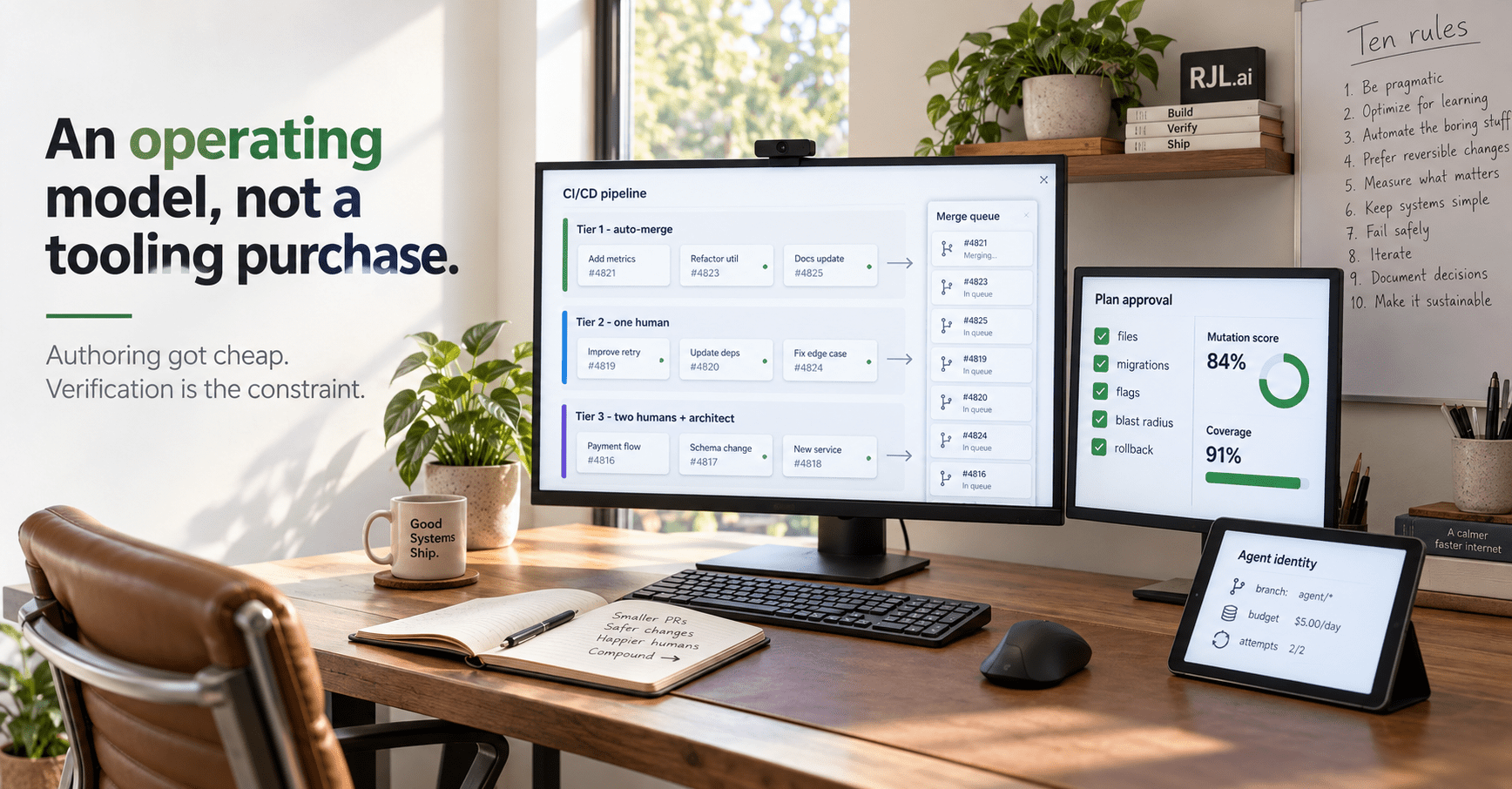
- Authoring is cheap. Verification is the constraint. Design review, test, and merge capacity before you scale generation.
- Individual output is not organizational throughput. Every serious dataset since 2024 shows the gap. Assume it applies to you until your own numbers say otherwise.
- Governance before scale. Retroactive policy lands after habits have formed and costs more to enforce.
- Baseline before adoption. A number without a pre-AI baseline is a story, not evidence.
- Measure outcomes, not activity. Cycle time, change failure rate, escaped defects, review latency. Not adoption percentage, not AI-authored lines.
- Humans own merges. An agent never holds merge authority on a protected branch. Every production change has a named human approver.
- The bar for AI-authored code is the bar for human code, applied with more suspicion. AI output is plausible by construction. Plausible is not correct.
- Agents are services. They get an identity, a permission scope, a sandbox, a budget, and hard rules, same as any other workload.
- The compounding asset is your context, not the model. Repo instructions, review rules, skills, evals, fixtures, and evidence are owned. Models are rented and will be swapped.
The queue has three outcomes
Authoring cost drops, so PRs get more frequent and larger. Faros AI measured it twice: in 2025, across more than 10,000 developers, PRs merged per developer rose 98 percent and review time rose 91 percent while company-level throughput did not move; in 2026, across 22,000, median review time was 5x and bugs per developer were up 54 percent. The review queue grows, and an organization responds in one of three ways.
- Review depth falls. Rubber stamps and no-comment merges. Faros's 2026 data has PRs merged with no human review up 31 percent and incidents per PR up roughly 3x.
- Review depth holds. The queue backs up. Cycle time stays flat and deployments per week go down. This is the version most teams end up running without ever deciding to.
- Verification gets redesigned. Plan approval, risk tiers, AI pre-review, a merge queue, and generated tests that carry a mutation score. Throughput rises with stability held.
Only the third branch produces an organizational gain. The other two produce a dashboard.
What the redesign contains
None of it is exotic. DORA's AI Capabilities Model names seven organizational capabilities that turn adoption into performance, and four of the seven are ordinary engineering discipline: strong version control, small batches, quality internal platforms, and a clear, communicated stance on AI. AI amplifies whichever you already have.
- The ticket is a contract. Acceptance criteria a machine can test against, the data contract, the rule or requirement it implements, the data classification it touches, the feature flag, the rollback plan, the risk tier. Tests-first, agent implementation, and release evidence all depend on this one upgrade, and an ambiguity check against the PRD runs before the ticket is accepted.
- Approve the plan, not the diff. The agent reads the repo and produces a plan: files, interfaces, migrations, flags, test surface, blast radius, rollback. A senior human approves or revises it before implementation starts. Reviewing a plan takes five minutes and catches architectural mistakes. Reviewing a 1,500-line diff takes an hour and catches typos. Plan approval is where senior judgment scales.
- Tests first, mutation scored. Generate the tests from the acceptance criteria before the implementation exists, then gate the modules that matter on mutation score rather than coverage, because AI writes tests that look thorough and assert nothing. Meta's TestGenEval benchmark had a frontier model at 35 percent coverage and an 18.8 percent mutation score. Feed the surviving mutants back to the model and most of that gap closes.
- Small batches, capped. Average PR size rose 154 percent in the 2025 telemetry. A soft warning at 400 lines and a split request at 800 is a reasonable start; stacked PRs and a merge queue make small batches cheap. DORA lists small batches as a core AI capability because it is the single practice that most directly counters the review-queue failure.
- Risk-tiered review. Docs, copy, tests, and safe-class dependency bumps auto-merge on green with a weekly human audit sample. Feature work behind a flag gets one human after AI pre-review clears the mechanical comments. Auth, money and eligibility math, PII paths, migrations, rule engines, and external adapters get two humans plus an architect, no AI auto-approve, and no agent-authored code. Uniform review collapses at volume; tiering is how the scarce hours land where they matter.
- Pin the model. A model upgrade is a change and goes through the same review as a dependency bump: run the eval suite, compare, then promote. Log the version on every agent action. Unpinned means unreproducible.
- The learn loop. Every escaped defect becomes a rule in the review agent's library. Every repeated task becomes a versioned, testable skill. Every rule and skill runs against a fixture set of real, sanitized PRs with known issues, so a rule that fires on the wrong things is caught before it trains reviewers to ignore all automated feedback. This is the compounding asset. Your review agent gets better at your codebase every quarter and a competitor's stays generic. The models are the same. The context is not.
Agents are services
An agent in CI gets what any other workload gets: an identity, a permission scope, a sandbox, and a budget. Its own service identity, not a personal token that belongs to whoever set it up and breaks when they leave. Write access to its own branch namespace and nothing protected. A tool allow list enforced in the harness, not requested in the prompt, because instruction files are advisory and the model will deviate under pressure. An ephemeral container per task with egress limited to the registries it needs. A per-workflow token budget, so a runaway loop costs twelve dollars rather than twelve hundred.
Then the hard rules, enforced in the workflow. It opens a PR and never pushes to a protected branch. It never modifies an assertion, deletes a test, or adds a skip to make a build pass. Two repair attempts, then it pages a human and stops. Every repair PR carries the original failure log. If it cannot produce a failing test for a bug, it posts its analysis to the ticket and stops; no patch without a repro. It never approves, merges, or re-requests review on its own work.
Start unattended work on the boring class: test backfill, dependency bumps, copy and i18n, lockfile drift, snapshot updates, release notes. Never on money and eligibility math, auth, PII paths, rule engines, or adapters to systems of record. Expand one work class at a time, gated on change failure rate holding flat. The safe class is boring on purpose. Work With Agents Like Senior Engineers is the other half of this: autonomy and accountability arrive together, for people and for agents alike.
Measure outcomes, not activity
Baseline before adoption: cycle time from ticket to production at p50 and p85, review latency and review time per line, change failure rate, escaped defects by tier, deployment frequency, and mutation score on the critical modules. If a clean pre-AI baseline does not exist, say so in every report rather than back-filling one. Then report the outcome metrics and refuse to report adoption percentage, AI-authored lines, or suggestions accepted as success. They go up while quality goes down, and they hand leadership the wrong dashboard.
The paradox test, run quarterly: if PRs per developer are up and any two of the following are true, you have a queue and a risk, not a gain. Deployments per week flat or down. Median review time up more than PR count. Change failure rate or incidents per deploy up. No-comment merges up.
How it fails
The failure patterns are consistent enough to list. Tool-first rollout before policy, measurement, or review standards exist. Measuring without a baseline, so every positive signal is credited to AI and every negative one to something else. Agents opening PRs into a review process designed for one human reading one human's diff. Coverage as the test gate. Personal tokens in CI. An instruction file written once and never reviewed, which the agent follows anyway. A model upgrade with no evals, so the defect class the review agent used to catch quietly starts escaping. Unattended agents on auth or money math because the safe class was boring. And a dashboard that says 90 percent of engineers use AI while nobody can tell the CFO what changed.
The compounding asset is your context, not the model. Repo instructions, review rules, skills, evals, fixtures, and evidence are owned. Models are rented and will be swapped.
Closing the gap between third-era tooling and second-era process is an operating model change. It costs more than the licenses, and it is the only part that pays back. The organizational side of that change, the trust and the workflow rather than the pipeline, is in Adoption Is a Trust Problem, Not a Tooling Rollout, and the numbers behind every claim above are in What the Data Says in August 2026.