I Make AI Ship in Production

RJ Lindelof - Engineering Executive | AI-native SDLC, regulated B2B SaaS

I'm a player-coach engineering executive with 20+ years leading teams in regulated HealthTech, EdTech, and B2B SaaS - and I still write code. I move agentic AI from pilot to production as a real delivery system, not a sandbox: code generation, test synthesis, and architecture scaffolding become first-class pipeline stages. I build high-velocity teams that ship, modernize the platforms underneath them, and prove every change with metrics instead of slideware. Two decades of regulated, high-stakes delivery come down to a handful of numbers - here they are.

Portrait of RJ Lindelof, engineering executive

Execution Principles

Strategy without execution is hallucination.

The Context Revolution

We've been optimizing the wrong thing.

For years, we architected systems around how we think - classes, layers, patterns, frameworks. Then frontier models matured, and the rules changed permanently. By May 2026 the model itself is table stakes: Claude Opus 4.8, OpenAI Codex 5.5, and Gemini are all remarkable straight out of the box. The fastest-moving teams aren't winning by writing better prompts, or even by picking the best model. They're winning by recognizing a deeper shift: AI operates on context, not abstraction. While competitors were prompt-hacking, winners were architecting context as a first-class concern. They standardized it (AGENTS.md, CLAUDE.md, CONTEXT.md, SCHEMA.md). They versioned it. They made it infrastructure. Your competitive advantage isn't your code anymore, and it isn't your model - it's how well you feed context to the models that generate your code.

The Context Revolution: Feeding AI Systems with Structured Context

Markdown is the Substrate

Markdown has become the de facto standard for AI-native organizations. It's token-efficient, easily parsed, and both human- and machine-readable. Strategic plans, architecture decisions, and product roadmaps all belong in version-controlled .md files. Markdown carries the human-readable context; JSONL carries the machine-readable side - training sets, eval logs, and agent traces. Together they are the substrate for building with AI.

Context as a Product

Requirements are now code, written in a language understood by both humans and AI agents. This is the essence of agentic development: designing with AI, not just prompting it. I call this the SP(IDE)R approach, turning ideas into structured, versioned artifacts that evolve with your codebase, not in a stale wiki.

AI Codes, Engineers Architect

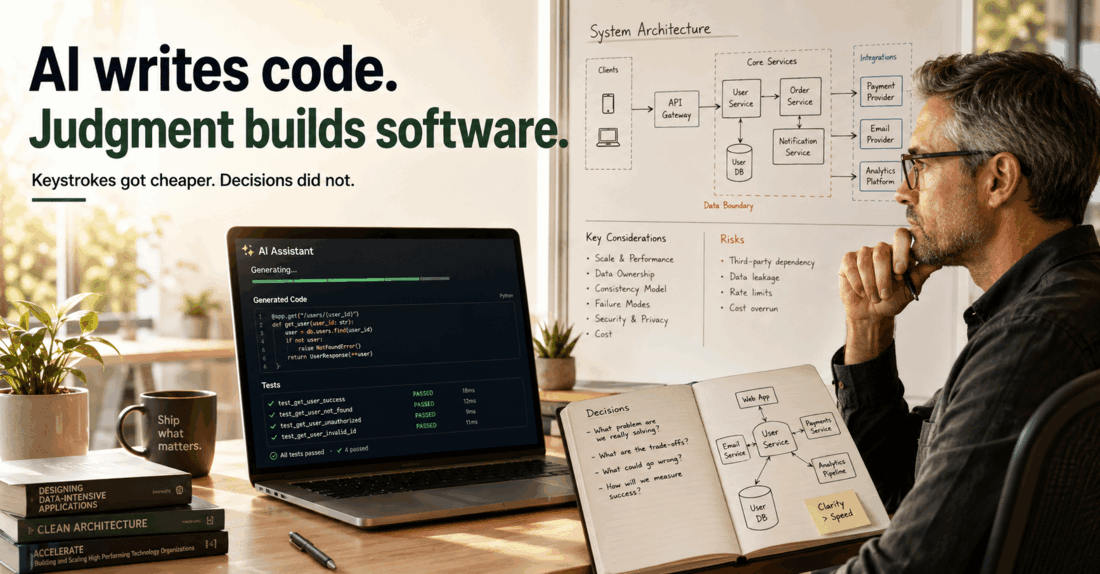
Generative AI excels at coding tasks, but software engineering is about building resilient, scalable systems. AI can write a function, but an engineer must architect the system. My approach leverages AI for the former, freeing up engineers to focus on the latter.

Leverage, Not Replacement

Senior engineers architect context. AI multiplies their expertise, automating repetitive tasks and scaling strategic work. This isn't about replacing engineers; it's about leveraging their experience to solve bigger problems.

MCP: The Protocol Layer for Agentic Infrastructure

The Model Context Protocol (MCP) and Agent-to-Agent (A2A) protocols are the connective tissue of production agentic systems. MCP lets AI agents reach into codebases, CI/CD pipelines, observability tools, and internal APIs - giving them real operational context, not just document summaries. When context is infrastructure and MCP is the protocol, AI agents stop being assistants and start being contributors with measurable SLOs.

The Intent Imperative

Context without intent is like a loaded weapon with no target.

Enterprise AI is undergoing its next major shift. For years, the competitive edge lived in prompt engineering, then context engineering - feeding the right information to the right model at the right time. That era is ending. The organizations pulling ahead now are investing in intent engineering: explicitly embedding goals, values, and trade-offs directly into autonomous agents before they act.

The boldest truth in enterprise AI today is this: an organization with a mediocre model and strong intent infrastructure will consistently outperform a company running a frontier model without alignment. Model capability is table stakes. Intent is the differentiator.

The Alignment Warning

Deploying autonomous agents without strict, goal-oriented alignment isn't just a technical risk - it's a business liability. Agents operating on context alone know what to do but have no principled basis for deciding whether they should. Context tells the agent what's true. Intent tells it what to value. Without intent, you've built a powerful system pointed at nothing in particular.

Speed Without Wisdom

AI can automate tasks with a flawlessness and speed that humans cannot match. That's the promise. The warning is equally real: the moment you remove the human context needed to intuitively navigate customer feelings, relationships, and organizational trust - speed becomes destruction. Automation that loses the human thread doesn't just fail to delight customers. It actively erodes the trust that took years to build.

Intent as Infrastructure

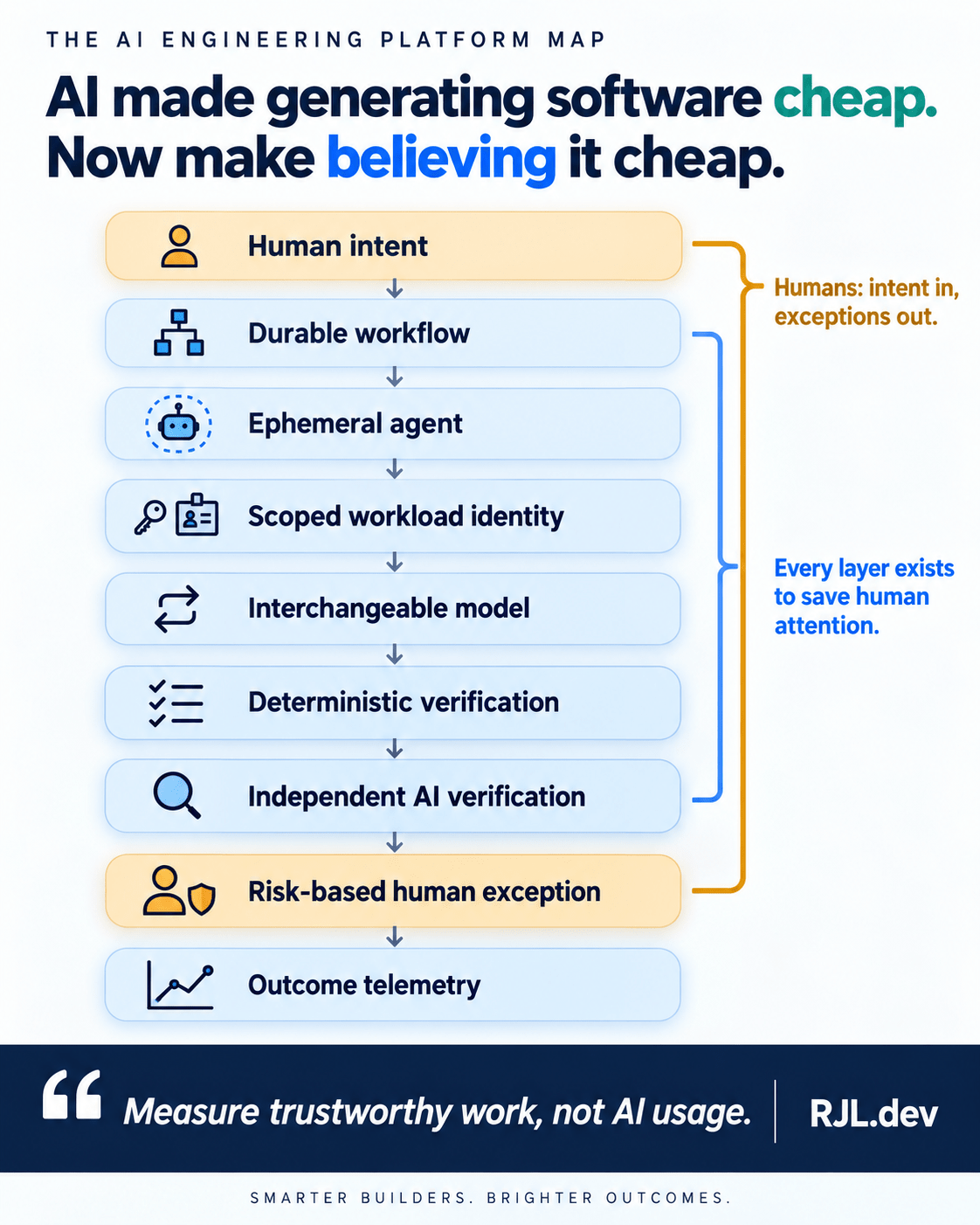
The teams I build treat intent the same way we treat context: as versioned, governed infrastructure. Before an agent ships, it gets an intent spec - a short, executable contract that names the outcome it owes the business and the boundaries it cannot cross: objective, success criteria, constraints, tool permissions, escalation triggers, stop rules, and a named owner. It lives next to the agent in source control, gets reviewed in PRs, and is enforced in CI through evals. If you cannot write the spec, the agent is not ready for production.

The 2026 Reality: Agents Are Outrunning Governance

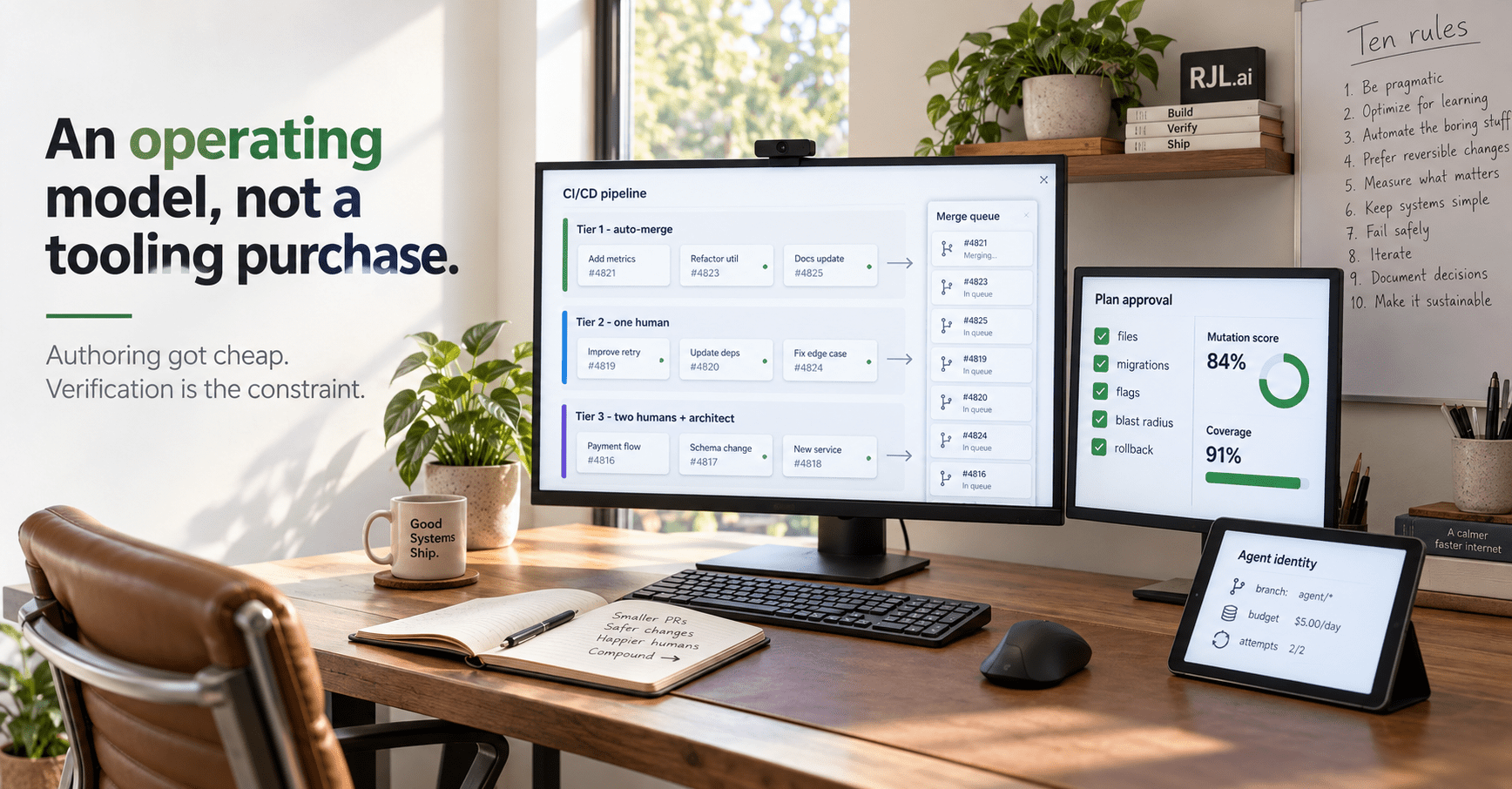
The next failure mode isn't a bad prompt - it's thousands of autonomous workflows with unclear ownership, loose permissions, and no shared operating model. Roughly three in four enterprise AI projects still fail to deliver business value, and almost never because the model wasn't capable. The fix is operational: agent inventories and owners, approval gates for irreversible actions (schema migrations, prod deploys, customer comms), and FinOps that tracks cost-per-outcome instead of burying token spend in the cloud bill. And the evals that gate it all measure whether an agent achieved its declared intent - not how it scores on a public benchmark. A model that tops the leaderboard but fails its intent evals is not shipping.

The AI Bottleneck Shift

You accelerated coding. Now everything else is the constraint.

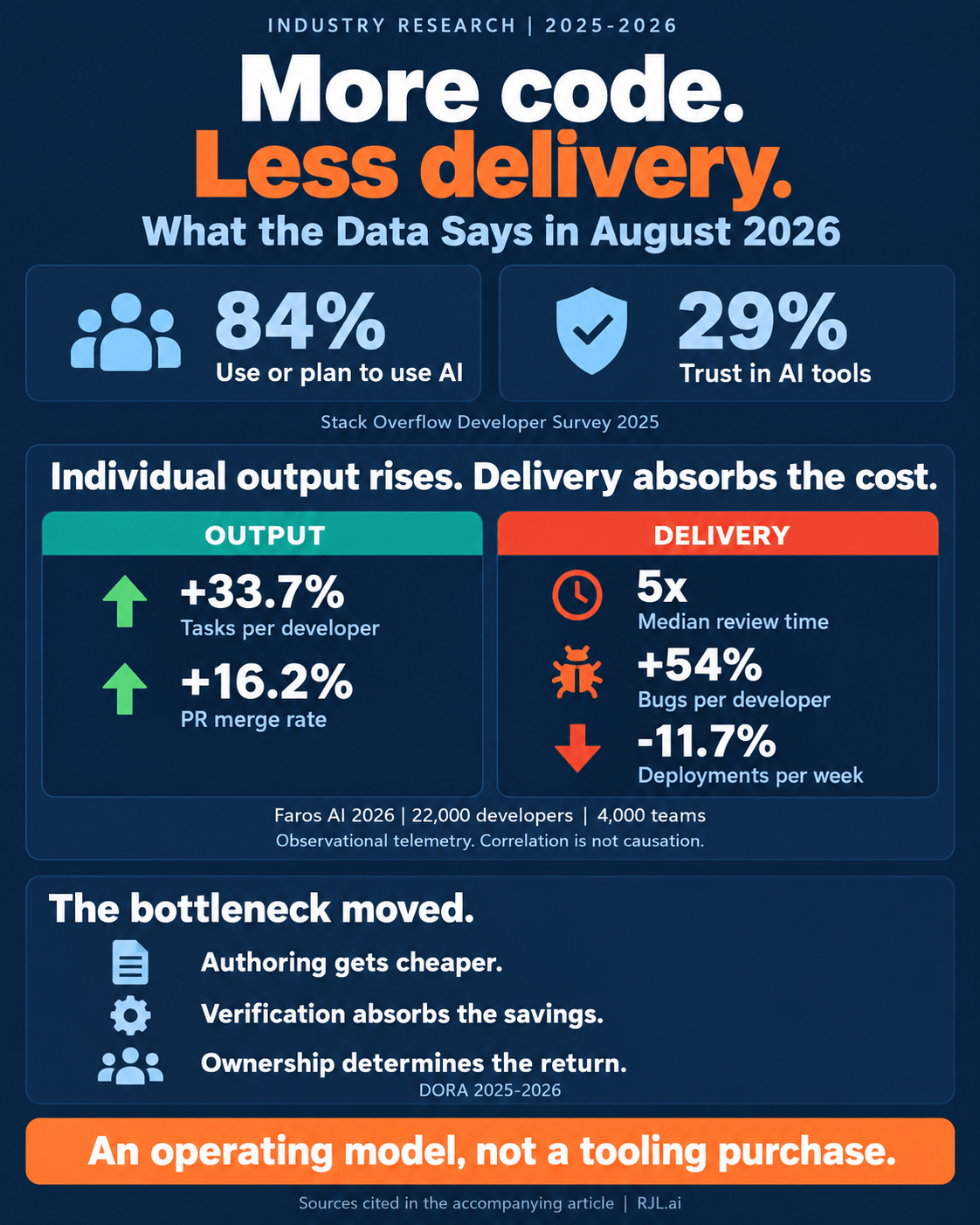
Teams adopting AI are experiencing a textbook example of the Theory of Constraints playing out in real time across the modern software development lifecycle. By applying AI to the coding phase, you have dramatically widened the pipe in the middle of your value stream. Because developers can write, refactor, and scaffold code faster than ever, the constraints have naturally shifted to the stages immediately before and after coding.

Shifting Bottlenecks in AI Software Development - AI speeds up coding but jams the value stream upstream and downstream

Upstream: The Backlog Starvation

This is becoming the most common complaint among product and engineering teams adopting AI.

Downstream: The Verification Traffic Jam

The bottleneck shifting to QA and release processes is the direct result of higher code volume hitting static pipelines.

How I Fix This

This is the exact problem I solve. Most teams stop at accelerating code generation. I treat the entire value stream as the system to optimize.

AI doesn't just make developers faster. The real win is accelerating the entire value stream so no single phase becomes the bottleneck. That's what I do.

How I Work

I integrate AI across the complete journey from idea to shipping - whether it's a new product or new feature.

Where I Focus

I turn AI from a buzzword into business leverage.

The Infrastructure Gap

Your laptop wasn't built for modern development.

AI inference, LLMs, Docker containers, Kubernetes, and resource-intensive builds are pushing local machines past their limits. The laptop designed for email and documents is now expected to run GPU-accelerated models, multiple databases, and complex CI/CD pipelines - and stay responsive while doing it. As I build internal developer platforms, where the dev environment itself runs becomes a real architectural decision.

I dig into this in depth - unbiased analysis of CDEs and developer-environment infrastructure, not vendor hype - at InfraGap.

From Idea to Shipping: The Complete AI Journey

Whether it's a new product idea or a new feature, AI accelerates every step from concept to customer.

1. Ideation & Validation

Start with market intelligence, not assumptions. AI analyzes market trends, competitor features, customer signals, and technical feasibility to validate ideas before engineering investment. Transform "we should build X" into data-driven "we should build X because Y."

2. Requirements & Architecture

Capture context in .md files that both humans and AI understand. Competitive analysis, user research, and architectural decisions become versioned, living documents. Requirements evolve with the codebase, not in disconnected wikis.

3. Rapid Prototyping & MLP

AI agents transform structured requirements into working prototypes. From specs to deployable MLPs, context drives wireframes, user stories, API designs, and initial commits. Validate faster, fail cheaper.

4. Development & Testing

Frontier models - Claude Opus 4.8 and OpenAI Codex 5.5 - pair with engineers through the entire development cycle. Code generation, refactoring, test creation, and security scanning all draw on the same context repository. Your team ships faster while maintaining quality.

5. Deployment & Launch

AI-enhanced CI/CD pipelines explain failures, suggest fixes, and optimize deployments. Agentic AI systems handle rollouts, monitoring, and incident response. Launch with confidence, scale with intelligence.

6. Post-Launch Optimization

Continuous feedback loops powered by AI. User behavior, feature usage, error patterns, and support tickets flow back into improvement plans. The cycle repeats: ideas -> validation -> build -> ship -> learn -> optimize.

This isn't linear. It's iterative. AI makes each cycle faster, smarter, and more reliable than the last.

What I Build

I don't just talk about AI. I lead teams that ship it in production.

Thinking face icon

AI-Powered Idea Validation & Market Research

Transform raw ideas into validated opportunities. AI analyzes market trends, competitor landscapes, customer signals, and feasibility to prioritize what to build first. Turn "what if" into "why this" before writing a single line of code.

Document icon

AI-Driven Competitive Intelligence

Automatically track competitors, analyze feature gaps, and identify market whitespace. AI agents monitor industry movements, extract insights from competitor products, and synthesize findings into actionable strategic documents.

Pencil writing icon

Executive AI Readiness & ROI

Assess where AI will actually earn its keep - and where it won't. Build the business case with cost-per-outcome economics, throughput and quality baselines, and a realistic adoption roadmap that earns executive sponsorship.

Toolbox icon

Agentic MLP Acceleration

AI agents pair with your team to go from structured specs to working prototypes. Context drives wireframes, user stories, and scoped commits.

Feedback loop icon

AI-Enhanced User Research & Feedback

Continuously gather and synthesize user feedback, support tickets, and usage patterns. AI identifies pain points, feature requests, and usability issues, converting them into prioritized improvement plans.

New user icon

Cross-Functional AI Adoption

AI adoption that reaches beyond Engineering into Operations, HR, and Product - moving teams from AI-curious to AI-proficient in deliberate waves. Adoption playbooks, training, and success metrics tailored to each department's workflows.

Developer collaboration icon

AI Pair Programming Environments

Real-time collaboration with frontier models - Claude Opus 4.8, OpenAI Codex 5.5, and GitHub Copilot. Markdown context flows into refactoring, AI-powered code reviews, and design sessions that level up every engineer.

Quality testing icon

Autonomous QA Agents

Test coverage that maintains itself from requirements, finds gaps, and flags issues before they hit staging. Context-aware, always current.

Documentation icon

AI Training & Enablement

Structured programs that move teams from AI-curious to AI-proficient. Role-specific training for engineers, product managers, operations leads, and executives. Measure adoption, not just attendance.

Security shield icon

AI Governance & Risk Frameworks

Data privacy policies, IP ownership guidelines, model risk assessment, compliance controls, and vendor evaluation criteria. Responsible AI that satisfies legal, security, and board-level scrutiny.

Pipeline automation icon

AI-Enhanced CI/CD

Pipelines that explain failures, suggest fixes, and improve themselves over time using structured context and agentic feedback loops.

Multi-agent coordination icon

Organizational Change Management

Executive alignment workshops, cultural resistance strategies, and phased rollout plans. Build internal champions, measure adoption velocity, and sustain transformation momentum beyond the initial pilot.

Rocket launch icon

AI Launch Strategy & Go-to-Market

From release planning to post-launch optimization, AI analyzes launch readiness, predicts rollout risks, and monitors adoption patterns. Context-aware agents generate launch checklists, rollout strategies, and optimization recommendations.

Developer platform icon

Internal Developer Platforms (IDPs)

Self-service platforms giving engineers governed access to CI/CD, observability, secrets, and AI agent tooling without filing tickets. New-engineer onboarding cut 70%. IDPs are the foundation that makes AI-native engineering sustainable at scale.

AI that ships. AI that scales. AI that frees your team to move faster and think deeper.

Proof, Not Promises

I've done this. I can do it for your company.

Across three SaaS engineering organizations - hc1, GlobalMed, and Successware - I moved AI from pilot to production and modernized the platforms underneath. The specifics, by company:

Different stacks, different industries, the same pattern: pick the right scope, prove value with shipping increments, instrument everything, and never let the rewrite freeze customer value. This isn't theory - it's what I've shipped.

What People Say

From engineers and executives who have worked alongside me.

"RJ transformed our platform modernization initiative. His AI-native approach cut deployment time by 60% while maintaining quality. A true leader who codes and mentors with equal skill."

Alexander Sante
SVP Engineering, Financial Services

"Working with RJ was a masterclass in cloud architecture. His expertise in AWS and Kubernetes helped us scale from 10K to 1M users seamlessly. He is the rare executive who can both strategize and debug production issues."

Michael Chen
CTO, Healthcare Technology

"Best mentor I have ever had. RJ does not just teach technical skills - he teaches you how to think like a leader. His 1:1s transformed my career trajectory from IC to tech lead."

Jiten Patel
Senior Engineer, SaaS Company

This isn't the future. It's shipping today.

You don't need a moonshot. You need a hands-on engineering leader who has already moved AI from pilot to production in regulated environments - someone who builds the governance and evals before scaling, earns trust before mandating, and ships measurable outcomes instead of demos. AI that ships, not AI theater. That's what I do.

Why RJ

A unique combination of technical depth, organizational leadership, and business acumen.

About RJ Lindelof

Headshot of RJ Lindelof, engineering executive and AI-native SDLC leader.

Most recently I led SaaS engineering at hc1 (healthcare analytics), and before that at GlobalMed (telehealth for the VA and White House Medical Unit) and Successware (PE-backed B2B SaaS). I lead with autonomy and accountability - set clear objectives, then get out of the way - hire for curiosity over credentials, and treat infrastructure and reliability as strategic peers, not a service desk. I have no patience for AI theater: I measure shipping velocity, reliability, and customer outcomes, not the appearance of work. In healthcare I've shipped Epic EMR integrations over HL7/FHIR and held HIPAA, SOC 2, and ISO 27001 posture in production.

I'm now looking for my next team: a growth-stage company past product-market fit - usually under 250 people - with a 10-to-60 engineer org that needs AI to actually work in production, ideally in HealthTech, EdTech, or another regulated B2B SaaS. I want a real product partner in the CPO's seat and a CEO who hires senior leaders and lets them operate. I'm in the Greater Chicago area, fully remote since 2019 and not relocating, though glad to travel for leadership offsites and key customers. Head of Engineering, VP of Engineering, or CTO depending on the stage.

Let's Discuss Your AI Transformation Strategy

A friendly robot mascot for RJL.ai, representing the future of AI-native development.