
Your RACI Role Says Whether to Attend
Meeting policy, applied across several orgs
You probably do not have too many meetings. You have too many people in them.
Your calendar is not a to-do list. But most engineers treat every invite like a summons.
The pattern
Here is the pattern I see everywhere: a meeting gets scheduled, someone adds "anyone who might care," and now eight people are sitting through a sprint planning session where two of them will speak and six will quietly answer Slack messages under the table.
Leading software engineering teams, I constantly see developers burning valuable deep-work hours in meetings they simply do not belong in. The culprit is defaulting to inviting everyone just in case.
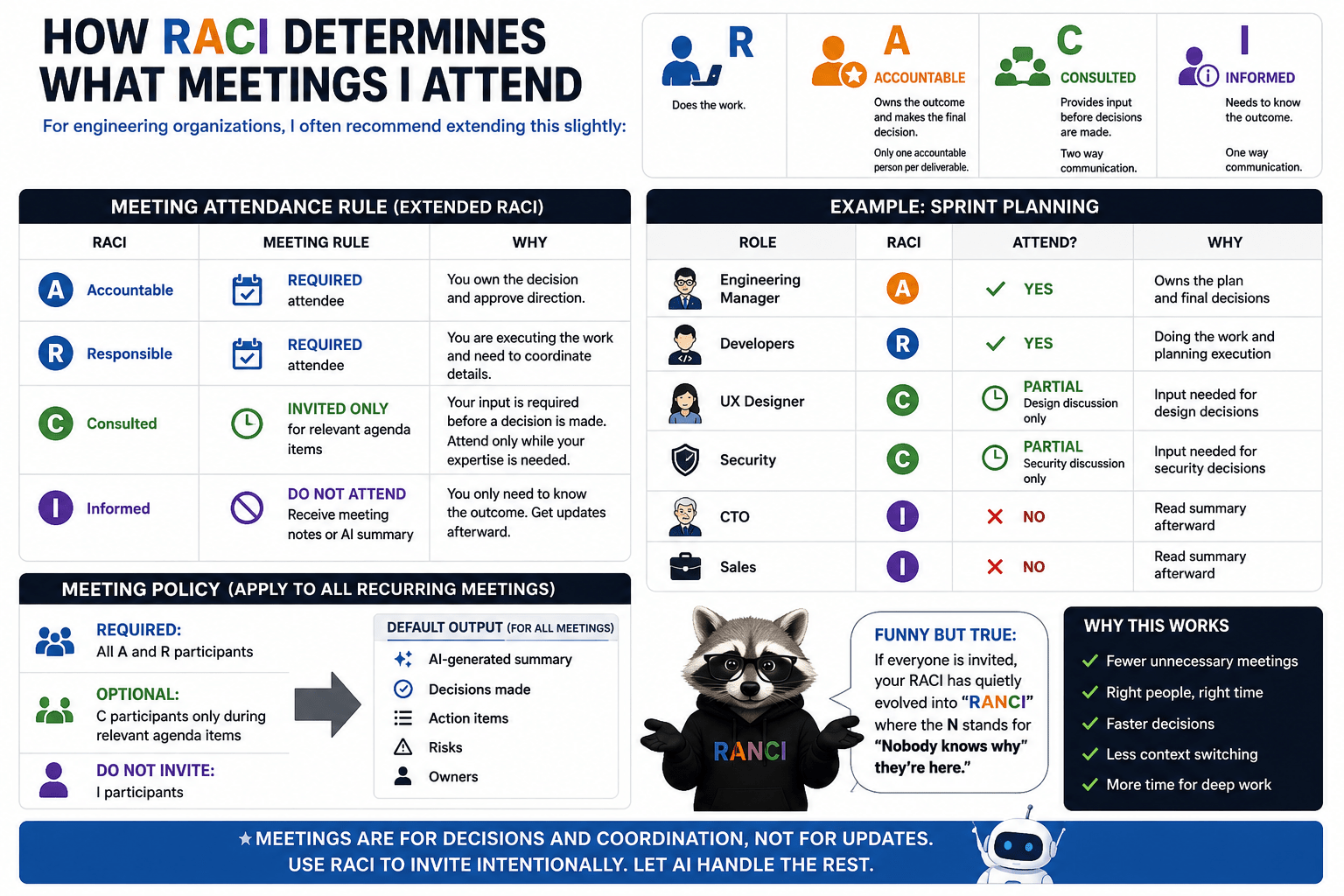
The fix is not a productivity hack. It is a decision-making framework most people learned once, forgot, and never applied to engineering. I use RACI to decide who should actually attend software engineering meetings:
- A - Accountable: Attend. You own the outcome.
- R - Responsible: Attend. You are doing the work.
- C - Consulted: Join only when your expertise is needed.
- I - Informed: Do not attend. Read the summary.
That last one is where most companies fail. We confuse "needs to know" with "needs to sit in a meeting." They are not the same thing.
The rule for recurring engineering meetings
For recurring engineering meetings, my rule is simple: A and R attend. C joins for relevant topics. I gets the AI-generated summary: decisions, actions, risks, and owners.
Take sprint planning. The lead who owns the sprint commitment is Accountable. The engineers picking up the work are Responsible. The platform engineer whose service one story touches is Consulted, and joins for that agenda item only. The stakeholder who wants to know when the feature ships is Informed, and reads the summary with the rest of the org.
This only works if somebody actually owns the decision. It is the same discipline that keeps a distributed team from building two different things: one name on the decision, written down. RACI at the meeting level is that discipline applied to the calendar.
RANCI
If everyone is invited, your RACI has quietly evolved into RANCI. The N stands for: Nobody knows why they are here.
It is a joke until you count the hours. Six engineers in a one-hour meeting where they had nothing to decide is most of a working day of deep work gone, every week, for a meeting none of them will remember. Send them the summary instead. If it turns out one of them needed to be there, that is a C you mislabeled, and you fix the label, not the invite list.
Fewer spectators. Faster decisions. More time to actually build software.