AI Did Not Replace QA. It Deleted the Typing
hc1, 2025-2026
Everybody keeps telling me AI is going to replace QA. On my team it did the opposite. It gave QA the most valuable seat in the pipeline, and most engineering leaders have not noticed yet.
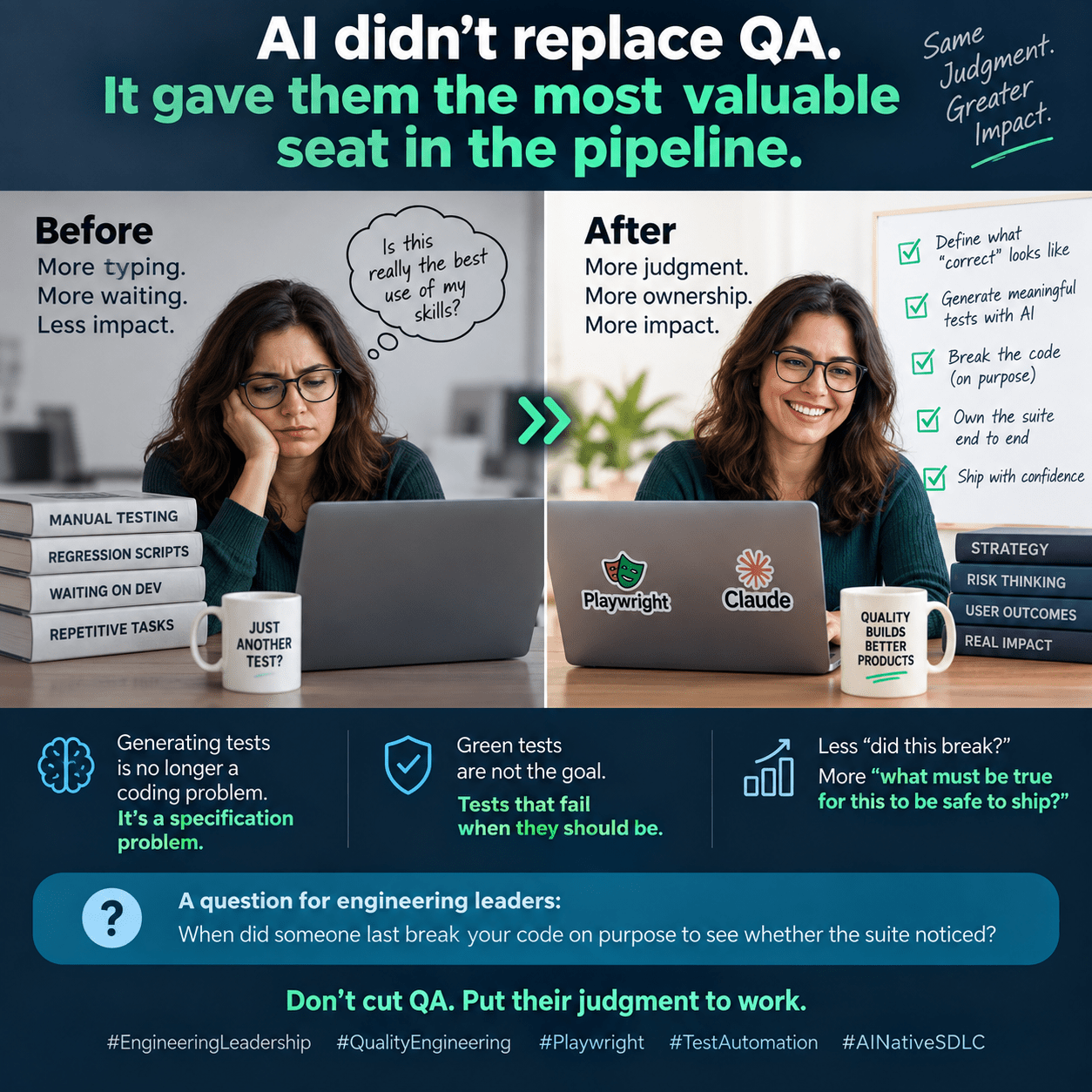
Here is what actually happened. I sat down with my quality team and taught them to generate Playwright suites with Claude. Not a vendor rollout. Not a center of excellence. A working session, a real repo, and a rule that we ship what we build.
The part I did not expect
The people who got good at it fastest were not the ones with the strongest coding background. They were the ones who were best at describing what correct looks like.
That makes sense once you see it. Generating a test is not a coding problem anymore. It is a specification problem. What state are we in, what does the user do, what must be true afterward, and what must never be true. Testers have been doing exactly that in their heads for their entire careers. They just had to hand it to a developer and wait.
The bottleneck was never their judgment. It was their typing speed in a language somebody else picked.
The failure mode is real, and it is quiet
Week one, you can generate two hundred tests in an afternoon. They will all be green.
Green is not the goal. Green is the easiest thing in the world to manufacture. A suite full of assertions that cannot fail is worse than no suite at all, because now you have coverage numbers defending code nobody verified.
So we changed what we grade. Not test count. Not coverage percentage. Whether the test fails when it should. Break the code on purpose and see if the suite notices. If it does not, the test is decoration.
That one practice did more for quality than any tool we bought. It is the same instinct, done by hand, that a mutation score automates: the operating model gates generated tests on whether they catch deliberately broken code, because coverage cannot tell a real assertion from decoration.
What the role actually became
- Less clicking through regression scripts. More deciding what deserves a test at all.
- Less waiting on an automation engineer. More owning the suite end to end.
- Less "did this break," which machines handle fine. More "what would have to be true for this to be safe to ship," which they do not.
That is a promotion, not a layoff. It is also a harder job, and some people will not want it. Be honest about that part instead of selling it as a free upgrade.
The broader point
AI did not replace quality engineering. It deleted the typing and exposed the judgment underneath, which is the same thing it did to the rest of us.
The teams cutting QA right now because the agents write tests are firing the only people in the building whose entire career has been spent learning what correct looks like. In a pipeline that generates code faster than anyone can read it, that is the last skill you should be letting go.
If your quality team is still writing the tests your developers hand them, you are paying for judgment and using it as a keyboard.
This is the quality half of where the bottleneck moved. The review queue got the attention, but the quality team was structurally guaranteed to become the next constraint once code arrived faster than they could test it. Handing them the generator instead of the backlog is how it did not.
One question for anyone running engineering
When did someone last break your code on purpose to see whether the suite noticed?
If the answer is never, you do not have a safety net. You have a screensaver.