The Model Leaderboard Moved Again. Plan for It
Menlo Ventures enterprise data, 2023 to 2026
In one year, Google's share of enterprise LLM API spend fell from 21% to 9% while the leader pulled further ahead. The lesson is not who is winning. It is that the board keeps moving.
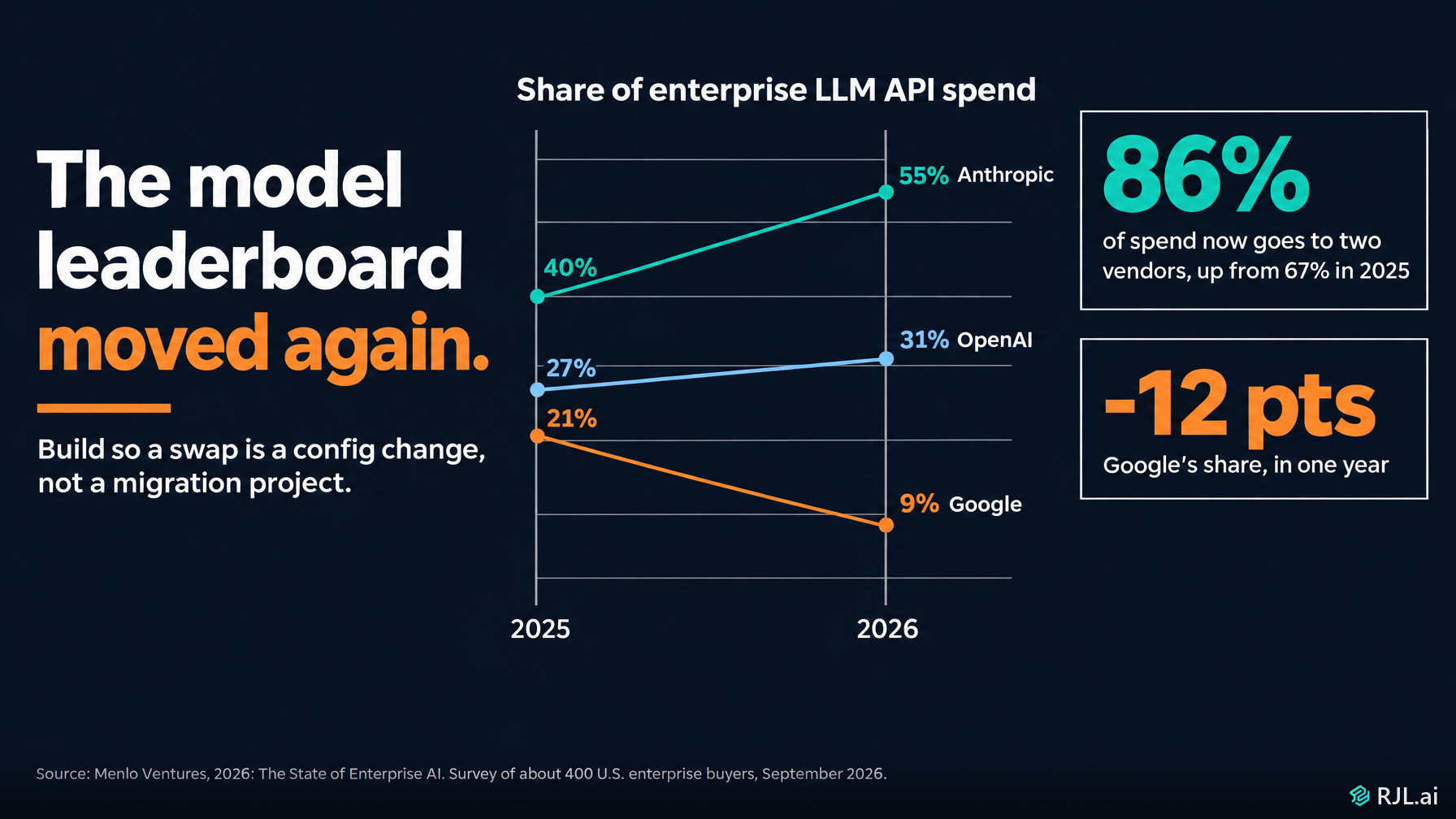
Menlo Ventures published 2026: The State of Enterprise AI on November 3. Its estimate of who gets the enterprise LLM API dollar: Anthropic grew from 40% to 55%, OpenAI from 27% to 31%, and Google fell from 21% to 9%. Anthropic and OpenAI together now take 86% of that spend, up from 67% a year earlier.
Put it next to Menlo's earlier editions and the shape is clearer. In 2023, OpenAI held half the market and Anthropic 12%. Three years, three different leaderboards.
Read the number before you use it
This is survey data, not audited revenue. Menlo surveyed nearly 400 U.S. enterprise decision-makers, fielded by Morning Consult in September 2026, and estimates share from each buyer's production API usage. Menlo is also an Anthropic investor and says so. Treat it as direction, not decimals.
The direction is still the story. One vendor lost more than half its share in twelve months. With total enterprise AI spend up more than fivefold, much of that swing is new money picking a different vendor rather than old workloads moving. Either way, the default enterprise choice changed in a year.
Concentration feels like stability. It is not
The tempting reading is that the market is settling: two vendors hold 86%, so pick one and standardize. That is the wrong conclusion from the same chart.
Concentration tells you where the money is this year. The swing tells you how fast it moves. Last year's number three looked like a safe enterprise choice, with the cloud contracts and the procurement relationships to prove it. Your stack does not care about market share. It cares about whether you can move when price, capability or a retirement notice changes the math.
What single-vendor lock-in actually costs
- Capability gaps you cannot close. Menlo says buyers keep putting capability ahead of cost and trading up to stronger models. If the stronger model belongs to a different vendor, a locked-in team watches.
- Price terms you cannot negotiate. Menlo notes the leading labs have started discounting even their flagship models. A buyer with a working second option gets that conversation. A buyer without one gets a renewal quote.
- A retirement calendar you do not control. Models get retired on the vendor's schedule. If yours is the only one you have tested, every notice becomes a fire drill.
Multi-vendor is not the goal. Switching is
Signing three contracts does not fix this. A team can use three vendors and still be locked in to each one, with prompts tuned to quirks and no shared baseline to compare them on. I covered the mechanics in Stop Picking a Model: your own eval set, verification that does not care who wrote the code, and a routing layer, so a swap is a configuration change.
My rule is to standardize on the interface and the eval set, never the vendor. Keep a second vendor running on a real slice of production work, not in a slide deck, so the switch path is something you have exercised rather than something you have described.
Three questions for this quarter
- What share of your AI spend and production traffic runs through one vendor? If you do not know, that is the first answer.
- If that vendor raised prices or retired your model with 60 days' notice, how long would the move take? Measured, or guessed?
- When did your eval set last run against a second vendor's model? The gap between the two scores is your lock-in, in a number.
The leaderboard will move again by next November. Build so you find out from your evals, not from your invoice.
The interchangeable model is layer five of the AI Platform Map, which starts with the next post. The multi-model strategy I run is on the approach page.