
When an Agent Can Approve the Merge
GitHub Copilot code review, fall 2026
An agent's approval can now count toward the reviews your branch requires. What does "approved" mean on your merge record after that?
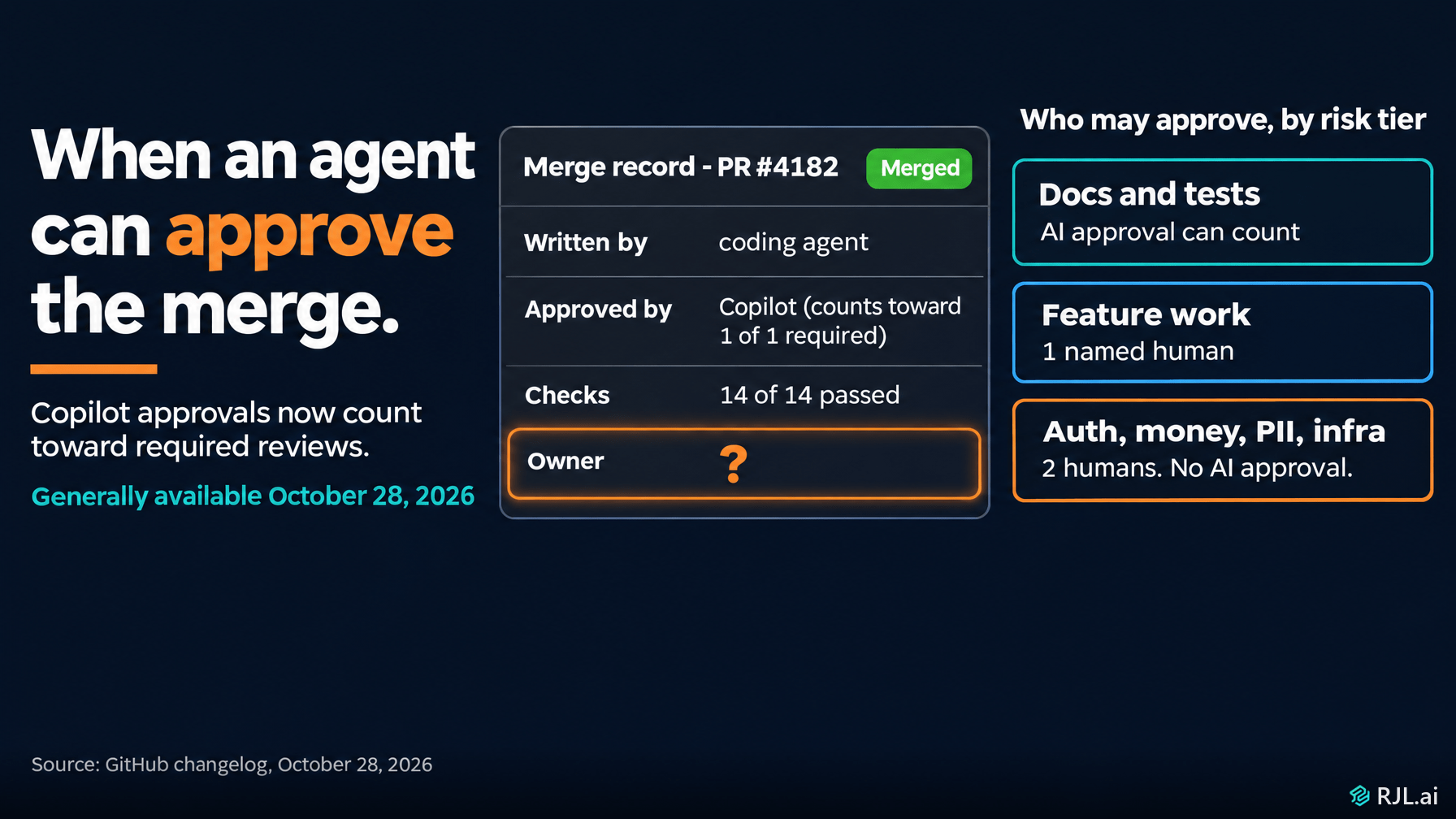
On October 28, 2026, GitHub made Copilot approvals generally available. It went into preview on September 1. When an admin turns it on, Copilot's code review can leave an approval, and that approval counts toward the repository's required approvals.
The guardrails are reasonable. It is off by default. An enterprise, an organization or a single repository has to opt in. A repository can limit it to file globs, so the approval only counts when every changed file matches. And a new push dismisses the approval.
None of that answers the question a leader has to answer first.
What a merge record used to mean
"Approved by" has always been shorthand for two things: a person read this change, and that person will answer for it. Required reviews exist to make the second part a rule. In a regulated shop, that line is also the change-management evidence an auditor samples.
An AI approval keeps the first half in a new form. A reviewer did look at the change, and the reviewer was a model. It cannot carry the second half. A model does not get paged, sit in the incident review, or remember the change next quarter.
The quiet stack is now a setting
In Agent PRs: Who Owns the Merge? I described the quiet stack: an agent writes the change, an agent approves it, and no person ever reads it. I wrote about the approval step as a preview. It is now generally available, a toggle in the settings page.
Every step in that stack is reasonable on its own. The sum is a merge nobody owns, and a merge record that says "approved" without saying by what.
It is not a bad feature
For a docs fix, a test-only change or a dependency bump with green checks, an AI approval is honest. It says a reviewer checked the change, and nobody pretends a senior engineer spent twenty minutes on a typo. That is a better record than the rubber-stamp human approval it replaces.
GitHub also shipped a Max review level in preview: several review agents on models from different providers, with an aggregator that reconciles their findings. That is the right instinct. A model approving its own vendor's output is checking its own homework; independent verification is the point.
My rule: an AI approval can count, but never alone above the bottom tier
- Docs, tests and generated files: an AI approval can satisfy the requirement.
- Standard feature work behind a flag: one named human approves. The AI review is input to that person, not a substitute.
- Auth, money, PII, migrations and infrastructure: two humans. No AI approval counts toward the total.
Then encode it. The file-path globs are not a convenience setting. They are where the bottom tier lives, so write them from your tier policy and keep the list short. Everything outside the globs keeps a human requirement, and the top tier keeps its code owners.
And the owner rule from the last post does not change: the human who dispatched the agent owns the merge. An approval, AI or human, is a review. Ownership is a name. Someone still has to sign.
Where I would start Monday
- Check the enterprise policy. The default is "Disabled everywhere." Leave it there until the tier policy is written, then enable it for selected organizations, not all of them.
- Turn it on per repository, with globs. Never with the file-path field blank, because blank means every file.
- Test your protected paths. GitHub's documentation does not say whether a Copilot approval satisfies a code-owner review. Find out on a sandbox repository before you rely on either answer.
- Count merges where the only approval came from Copilot. Report it next to merges with no human review. Most review dashboards count approvals, not approvers.
An approval used to mean somebody would answer for the change. It still has to. If the approver cannot be paged, the owner has to be someone who can.
The review tiers come from Where the Bottleneck Moved, and the layer of the platform where a person takes over from automated review is Humans Are the Exception Path.