Who Signs for Agent-Written Code?
Regulated delivery, September 2026
Your auditor is going to ask who approved the change. On a growing share of your pull requests, the honest answer is nobody.
Change management is the oldest control in software. Someone other than the author reviews the work and puts their name on it. That control survived waterfall, agile, DevOps, and every reorg in between.
Agents broke both halves of it. The author is not a person anymore. And increasingly, the reviewer is not either.
The numbers are already uncomfortable
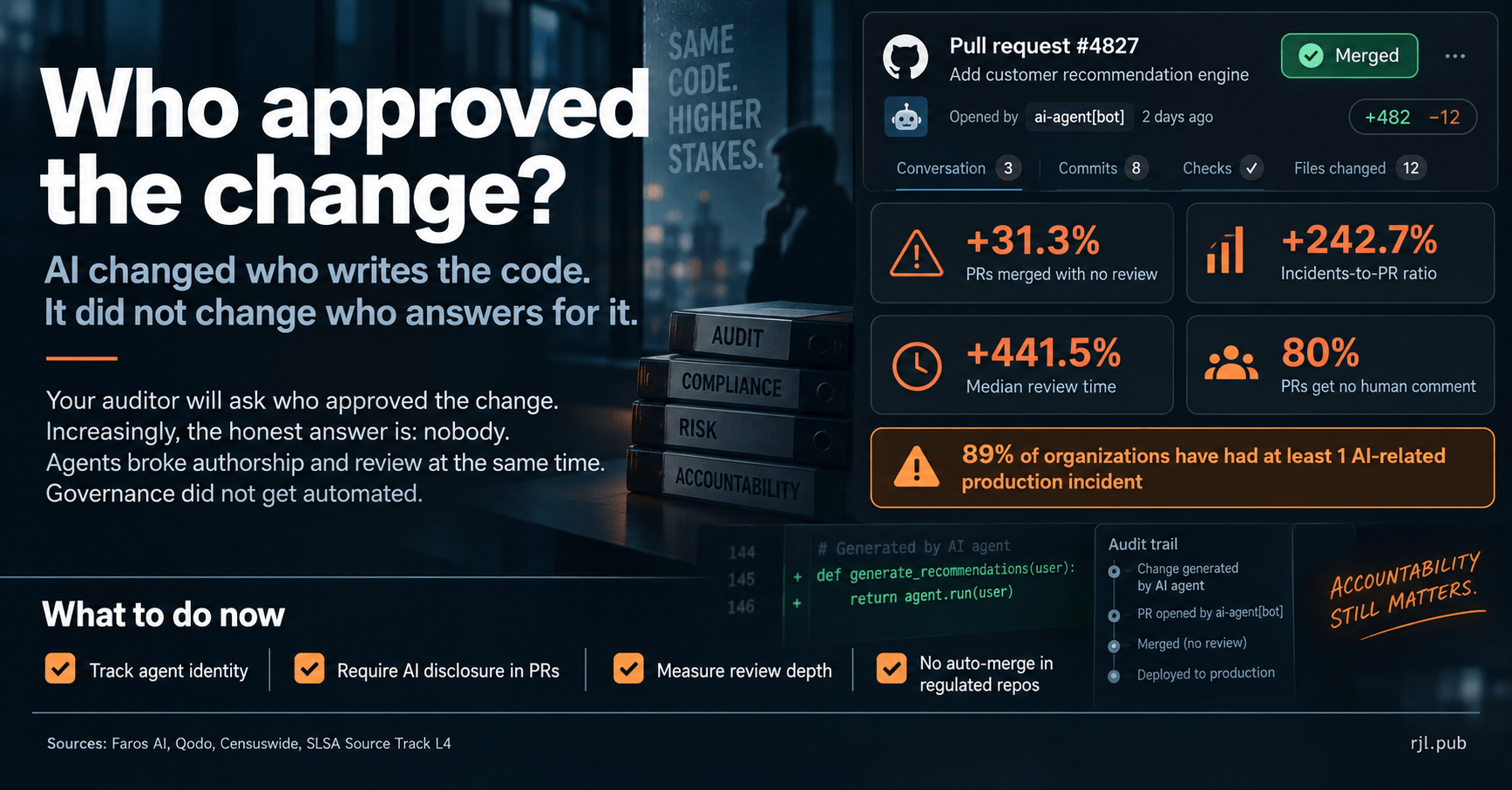
Faros AI, "The Acceleration Whiplash," 2026. Two years of telemetry, 22,000 developers, 4,000 teams, measured as each organization moves from its lowest AI adoption period to its highest. PRs merged with no review at all, human or agentic: up 31.3%. Incidents-to-PR ratio: up 242.7%. Median review time: up 441.5%.
Qodo, surveying 100 engineering directors and VPs across financial services, healthcare, technology and telecom: 94% use AI coding tools. Only 12% are very confident in that code before it reaches production. 62% still run manual peer review as their primary quality gate.
And this one, from Qodo's own product telemetry: when an AI review tool is enabled, 80% of PRs get no human comment at all. Qodo publishes that as a feature. Read it as a governance statistic instead of an efficiency one and it changes color fast.
We are shipping code we do not trust, through a review gate that is quietly unstaffed.
This is not a forecast. Separate research, Censuswide, 500 US enterprise engineers and engineering leaders, March 2026: 89% of organizations have already had at least one AI-related production incident. One in four has had a full system outage traced directly to AI-generated code.
The part nobody has fixed yet
SLSA Source track L4 requires two-party review. An agent that opened the PR plus one human who clicked approve is not two parties. It is one party and a tool. Count the agent as zero.
There is still no standard for agent identity in build provenance. No attestation field that records which model, which version, under whose authority.
So when the auditor asks who approved the change, "an agent did" is not an answer. Neither is a green check mark.
Now ask the harder version of that question: what happens when the agent is the reviewer too? That is where the two-party rule does not bend, it collapses. And it is already happening in repos that turned on AI review and auto-approve in the same quarter. Zero parties, one merge, full audit trail showing green.
The fix is boring, and it is yours
- Agent identity in the commit trailer until a standard exists.
- A PR template that asks three things: AI-assisted yes or no, which tool, what a human verified and how.
- Review depth tracked as a metric, not assumed as a behavior.
- No auto-merge path in a regulated repository. None.
This is not anti-AI. I run agents across my lifecycle and I am not giving them back. But accountability did not get automated. It got concentrated, and it landed on the humans still holding the titles. The operating model says it in one rule: humans own merges. An agent never holds merge authority on a protected branch, and every production change has a named human approver. The rest of this essay is what that rule costs to actually enforce.
AI changed who writes the code. It did not change who answers for it.
Pull your last 20 merged PRs
Count how many have a human name on the approval and a note on what that human actually verified.
I pulled mine. Human name on the approval: 7. Human note on what was actually verified: 2. The gap between those two numbers is the whole problem, and it is the number I am working on.
Accountability did not get automated. It got concentrated.